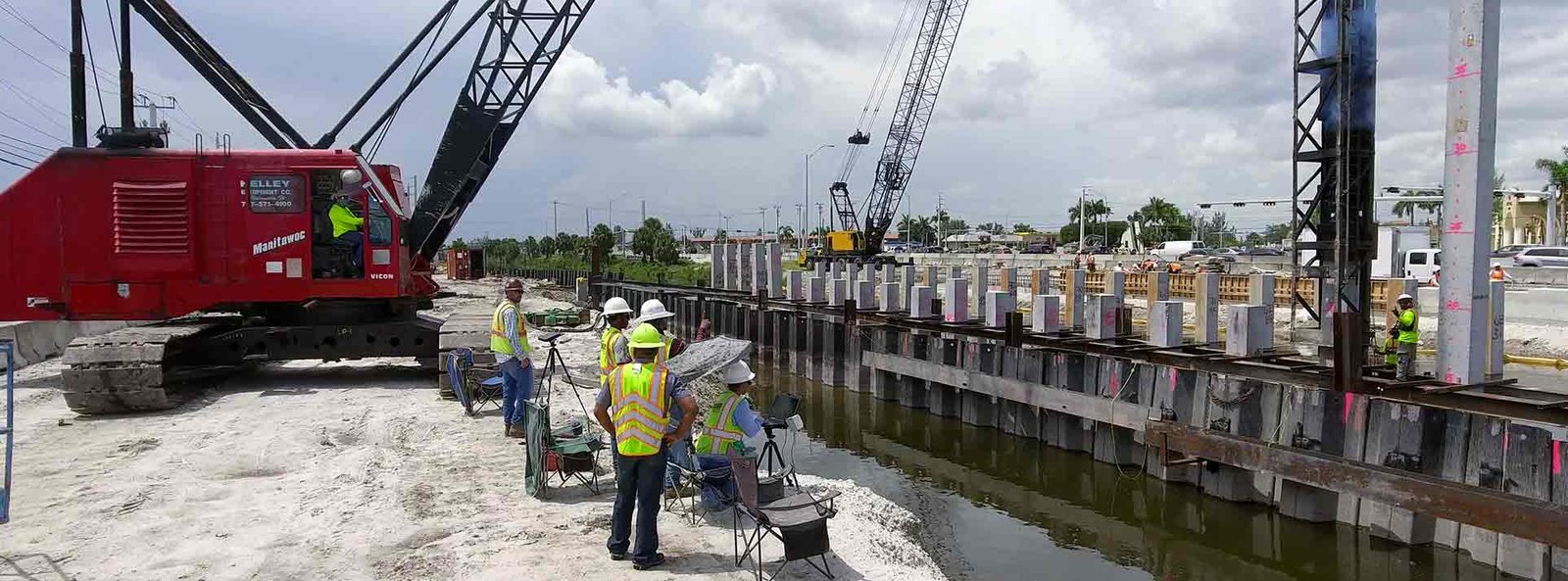
Understanding Rotary Piling: The Engineering Behind the Method
Before choosing a contractor, every project owner deserves to understand what rotary piling actually involves and why it performs better than older alternatives in complex urban environments.
Rotary drilling piling works by using a mechanised rotary rig to drill cylindrical boreholes into the ground. A helical auger or bucket drill bit rotates under high torque, cutting through soil and rock layers. Once the shaft reaches the required depth, it is cleaned, reinforced with a steel cage, and filled with concrete.
The result is a structural pile with:
- High axial load capacity
- Tight dimensional control over diameter and depth
- Minimal vibration protecting neighbouring structures
- Suitability for hard rock, clay, silt, and mixed ground conditions
This method aligns with guidelines from the Bureau of Indian Standards (IS 2911), which governs pile foundation design and construction across India a standard that Vijay Infra strictly follows on every project.
Why Mumbai's Ground Conditions Demand Specialist Contractors
Mumbai does not offer forgiving geology. Site conditions vary dramatically across the city's different zones:
- South Mumbai and coastal areas: Soft marine clay, low bearing capacity, high water table
- Central suburbs (Andheri to Thane): Mixed fills, silty soils, variable rock depth
- Navi Mumbai and reclaimed zones: Loose hydraulic fills, compressible layers, significant settlement risk
- Eastern Mumbai and Vikhroli belt: Shallow hard rock with abrupt transitions
Each of these scenarios demands a different approach to rotary bored piling — different rig torque settings, drill tooling, casing depths, and concrete mix designs. Generic contractors without Mumbai-specific experience frequently run into pile deviation, premature refusal, or concrete contamination.
Vijay Infra has built its expertise specifically around these local ground challenges. Their site engineers study borehole logs and soil investigation reports before mobilising a single piece of equipment. That preparation makes every phase of execution smoother and more predictable.
What Sets Vijay Infra Apart From Other Rotary Pile Contractors
There are several rotary pile contractors operating across Mumbai. However, not all deliver the same standard of workmanship, documentation, or site management. Here is what differentiates Vijay Infra:
Experienced Engineering Team
Vijay Infra employs geotechnical and structural engineers with hands-on experience across Mumbai's diverse project landscape. They understand load transfer mechanisms, pile group behaviour, and settlement analysis — not just drilling mechanics.
Modern Rig Fleet
Their equipment fleet includes high-torque rotary rigs capable of handling both soft soil and hard rock formations. This flexibility means Vijay Infra never compromises pile quality due to equipment limitations.
Strict Quality Protocols
From pile verticality checks to concrete pour logs and integrity testing, every pile undergoes documented quality control. This discipline supports smooth third-party audits and structural certifications.
Transparent Project Communication
Clients receive regular updates on progress, deviation reports, and load test results. There are no hidden surprises when Vijay Infra manages your piling scope.
Large Diameter Piling for High-Load Structures in Mumbai
When projects involve towers above 20 floors, heavy podium structures, or concentrated column loads, standard pile diameters simply cannot carry the required load. This is where large diameter piling becomes essential.
Vijay Infra routinely executes pile diameters ranging from 750mm to 1500mm — and beyond in special cases. Large diameter piling allows engineers to reduce the number of piles per column while maintaining the required factor of safety. This simplifies pile cap design and speeds up substructure construction.
For Mumbai's high-density residential towers and commercial complexes, this approach has proven both structurally sound and commercially efficient. Vijay Infra has completed large-diameter scope for projects ranging from 25-floor residential blocks in Thane to multi-use commercial developments in the Bandra-Kurla Complex corridor.
Heavy Foundation Piling: Built for Mumbai's Most Demanding Projects
Infrastructure projects — metro viaducts, flyovers, bridge piers, and industrial facilities — impose loads that go far beyond what residential construction demands. Heavy foundation piling in these contexts requires rigs with significantly higher crowd force and torque, specialist tooling for rock socketing, and more rigorous quality assurance.
Vijay Infra has successfully delivered heavy foundation piling scopes across Mumbai's infrastructure corridor. Their team understands the pace and documentation requirements of government and semi-government infrastructure contracts — completing work within tight programmes without sacrificing structural integrity.
Real Project Insights from Vijay Infra’s Ground-Level Execution
During a recent high-rise residential project in Navi Mumbai, the site team encountered an unexpected transition from soft marine clay to hard basalt within a short horizontal distance. Rather than applying a one-size-fits-all approach, Vijay Infra adjusted rig torque settings pile by pile, switched tooling mid-project, and completed the full scope without a single rejected pile.
On a commercial development in the western suburbs, waterlogged ground conditions required temporary casing installation to prevent borehole collapse. Vijay Infra's team mobilised the appropriate casing equipment within 24 hours, keeping the project on schedule and within budget.
These are not isolated examples. They reflect how Vijay Infra operates — with technical flexibility and on-ground problem solving that only real experience can deliver.
Customer Testimonials
Suresh Patil, Project Director — Thane High-Rise Residential Project: "We have worked with multiple piling contractors over the years. Vijay Infra brought a level of preparation and professionalism we had not seen before. Their soil review, equipment choice, and documentation were all spot-on. We will definitely partner with them again."
Kavita Nair, Senior Structural Engineer — Navi Mumbai Commercial Development: "Our site had terrible ground variability. Vijay Infra's team adapted without any drama. Piles were installed accurately, load tests passed for the first time, and the quality file was complete. That kind of reliability is rare in this industry."
Frequently Asked Questions
Q1. What soil types are suitable for rotary bored piling in Mumbai? Rotary bored piling works effectively in soft clay, silty soils, sandy fills, and hard rock formations — all of which are found across Mumbai. It is one of the most versatile deep foundation methods available for the city's variable ground conditions.
Q2. How do I know if my project needs large diameter piling? Structural engineers determine this based on column loads, pile group configuration, and bearing stratum depth. Generally, buildings above 15 to 20 floors and heavily loaded infrastructure structures require large diameter piling solutions.
Q3. Are Vijay Infra's rotary pile contractors certified and insured? Yes. Vijay Infra operates with certified engineers, trained rig operators, and appropriate project insurance. All piling work follows IS 2911 standards and is supported by full quality documentation.
Q4. How long does rotary drilling piling take for a typical high-rise project? Duration depends on pile count, diameter, depth, and site access. For a typical 30-floor residential tower, rotary drilling piling work generally ranges from four to eight weeks, subject to site conditions and programme requirements.
Q5. Can Vijay Infra handle both residential and infrastructure piling projects? Absolutely. Vijay Infra has successfully delivered piling scopes for high-rise residential towers, commercial complexes, and heavy infrastructure projects across the Mumbai Metropolitan Region.
Conclusion
In a city where the stakes of construction failure are measured in lives, livelihoods, and investments, foundation quality is never a place to cut corners. Mumbai's demanding geology, dense urban fabric, and increasingly ambitious development pipeline require piling contractors who bring real expertise not just equipment. Vijay Infra has earned its position as a trusted name in rotary piling services in Mumbai by consistently delivering technically sound, well-documented, and professionally managed foundation work across the city's most challenging projects. From rotary drilling piling in waterlogged zones to large diameter piling for high-rise towers and heavy foundation piling for infrastructure corridors Vijay Infra handles it all with the confidence that only deep experience can build. If your Mumbai project demands a foundation partner who prepares thoroughly, executes precisely, and documents completely reach out to Vijay Infra today.